Writrox

Resume Writing Tips

Are you looking for resume writing tips? Then, Writrox is right here for you and got you cover with all the tips blog posts. Visit and read now!

resume tips for senior software engineers 

Resume Tips for Senior Software Engineers: How to Stand Out After 10–20 Years

So you’ve been writing code for 10, 15, maybe even 20 years now. And somewhere along the way, you probably realised your old resume just isn’t cutting it anymore. Half the bullet points feel outdated, the format looks stuck in another decade, and it doesn’t say much about who you’ve become as an engineer. Here’s the thing. A resume at this stage of your career isn’t a formality. It’s often the first impression a hiring manager gets before they ever talk to you, and it needs to carry the weight of everything you’ve built, led, and figured out over the years. This blog is going to walk you through exactly that, structure, wording, formatting, all of it, so your experienced software engineer resume actually reflects the depth of your experience instead of hiding it behind generic phrasing. Why Senior Software Engineer Resumes Need a Different Approach Here’s something a lot of engineers don’t realise until they’re deep into a job search: the resume that got you your first job is nothing like the resume that should be getting you your fifth or sixth. Early career resumes are built around potential. Yours needs to be built around proof. Recruiters aren’t scanning for keywords like “quick learner” or “team player” anymore. They want numbers. They want outcomes. They want to know what you actually built and, more importantly, what happened after you built it. A lot of senior engineers make the mistake of just adding more bullet points onto an old resume template every time they update it. More isn’t better here, not even close. What matters is relevance, clarity, and the story your career tells when someone skims it in under 30 seconds. That’s really the crux of good resume tips for senior software engineers: less clutter, way more substance. There’s also a positioning problem that shows up a lot. Ten years of experience doesn’t automatically mean ten years of growth. If your resume reads like you did the same job on repeat across different companies, that’s going to work against you, no matter how skilled you actually are. A different approach means showing progression, not just tenure. Also Read: Resume Tips for Senior Management Professionals What Recruiters Expect from Professionals with 10–20 Years of Experience Recruiters reviewing a senior software engineer resume aren’t looking for a list of technologies you’ve touched. They’re looking for signals of ownership and judgment. Here’s roughly what’s going through their head: Has this person led anything, or just executed tasks handed to them? Did their work move a business metric, not just a technical one? Can they operate at a strategic level, thinking about architecture, tradeoffs, and team growth? Is their tech stack current, or stuck in 2015? At this stage of a career, recruiters expect maturity in how you present yourself. Vague statements like “worked on backend systems” don’t cut it anymore. They want to see the scale, the complexity, and the outcome. This is also why looking at a few solid software engineer resume examples before you sit down to write can save a lot of back and forth later. Essential Elements Every Senior Software Engineer Resume Should Include Let’s break down what actually needs to be on the page. Senior-Level Professional Summary Skip the objective statement. Nobody needs to know you’re “seeking a challenging role.” Instead, open with three or four lines summarising your years of experience, your domain expertise, and your biggest wins. Think of it as an elevator pitch, not a mission statement. Relevant Technical Skills This is where a lot of senior engineers go wrong; they list every single tool they’ve ever opened once. Be selective. Your skills for software engineer resume section should reflect what you’re actually strong in and what’s relevant to the roles you’re targeting. Also Read: Top 20 Skills to Write in Resume Clear Career Progression Recruiters want to see growth. Titles moving upward, scope expanding, and more ownership over time. If your resume reads flat, like you did the same job for 15 years across three companies, that’s a problem worth fixing in how you frame things. Quantifiable Achievements and Business Impact Every senior engineer should have metrics attached to their work. Reduced latency by how much? Saved how many engineering hours? Scaled a system to handle what kind of load? Numbers make claims believable. Technical Leadership and Mentoring Experience Even if you were never a manager, if you mentored juniors, ran design reviews, or influenced technical direction, that counts as leadership. Say so. Major Projects and Architecture Experience This part of the resume tends to carry the most weight, and for good reason. Systems built from the ground up, migrations pulled off under pressure, architecture calls that are still paying off years later, are where a senior engineer’s resume actually starts to look senior. How to Write a Senior Software Engineer Resume That Gets Interviews Define the Target Role and Career Direction Figure out the destination first. Staff Engineer? Engineering Manager? Some niche technical specialist track that doesn’t even have a clean job title yet? Whatever it is, a resume template for experienced software engineer roles needs to point there directly. A generic version aimed at “any job with engineer in it” rarely lands anywhere. Focus on Recent and Relevant Experience That jQuery project from 2011 isn’t doing anyone any favours. Recent roles deserve the space; older ones can be summarised in a line or two. As a rule, the last eight to ten years should carry almost all of the weight on the page. Convert Responsibilities into Quantifiable Achievements Every “responsible for” bullet is a missed opportunity. Rewrite it as a result instead. “Responsible for backend development” becomes something closer to “redesigned backend service handling 2M+ daily requests, cutting response time by 40%.” One small shift like that changes how the whole resume reads. Highlight Technical Leadership and Strategic Impact Leadership shouldn’t be hiding behind technical language three bullets deep. A decision that saved money, or one that quietly prevented a

Resume Tips for Senior Software Engineers: How to Stand Out After 10–20 Years Read More »

resume tips for senior

Best Resume Tips for Senior Management Professionals

Senior management roles are among the highest-paid professions in the job market. Hence, they’re also the most competitive. More than 200 applicants compete for a single Vice President, GM, Director, or CXO position. Since there are so many applicants, recruiters spend less than seven seconds reading each resume. So, if you want to stand out from the competition and make sure the recruiter reads your resume, you need to position and write it accordingly.  However, generic, template-based resumes are always scrapped because almost every competitor uses the same type of resume. To increase your chances of getting hired, you need to position your resume to highlight your expertise, experience, and leadership resume skills.  In this guide, we’ll give you some actionable and effective tips for VP, Director, GM, and C-suite candidate resumes to make sure you stand out and get noticed. If you still can’t figure out what to write and put on your resume, Writrox’s executive resume writing services can help you with it. Why a Senior Management Resume Is Different from a Regular Resume The main difference between a senior management resume and a regular resume is that in an executive-level resume, you should focus on your experience in decision-making, planning strategically, and expanding businesses.  Applicants should always display their impact on revenue growth, profit improvement, leadership of large teams, organizational transformation, M&A, or other similar factors. A senior management resume should focus more on the results achieved. Executives should use terms associated with leadership, business growth, operational excellence, strategic thinking, and stakeholder management. Senior management resumes are generally two to three pages long because of the advanced experience of these professionals. Often, people use free online resume templates, but they don’t suit executive candidates and won’t help you get hired at all. What you should do instead is try to make a better resume yourself. 7 Best Resume Tips for Senior Management Professionals Here are some resume tips that senior management professionals can implement in their resumes: 1. Lead with a Powerful Executive Summary, Not an Objective When applying for senior positions, begin your resume with a solid Executive Summary or Profile rather than a career objective, as this section won’t fit an executive candidate. The summary should be brief yet informative.  Mention the years of leadership experience, the industries you’ve worked in, the scope of leadership you’ve had, and the achievements you’ve received. Try to quantify all these achievements and use numbers. For example, write about how large the teams that you led were or how much budget you’ve managed. Here is an example of how to write an executive summary: P&L leader with 18+ years of experience driving INR 500 Cr+ revenue growth across BFSI and SaaS verticals, while leading cross-functional teams of 300+ professionals. 2. Quantify Leadership Impact With Metrics One mistake senior professionals make in their resumes is listing job responsibilities instead of focusing on accomplishments and measurable results. Metrics such as revenue growth, cost savings, EBITDA growth, business transformation success, successful mergers, customer acquisition growth, and others are valuable on your resume. One of the most effective formulas used by executive resume writers is the CAR formula. It stands for Challenge, Action, and Result. It means you should mention the problem your business faces, the actions you took to address it, and the results you achieved. Ideally, you should have at least one number or metric included in each bullet point in your resume. 3. Highlight Strategic & Board-Level Contributions Senior management hiring considers not only the executive’s ability to perform his or her job effectively but also the ability to influence the company’s strategy in certain areas. You need to highlight in your resume your experiences in presenting information to the Board, communicating with investors, participating in mergers and acquisitions, implementing digital transformation initiatives, expanding the business to new markets, etc. Finally, you should highlight your experience in stakeholder management. It means mentioning your interactions with CXOs, regulators, government bodies, private equity funds, venture capitalists, and international partners. 4. Optimize for ATS Without Losing Executive Polish Most recruiters use Applicant Tracking Software (ATS) nowadays to filter resumes. So, you need to make sure that your resume is compatible with ATS. Many professionals get overlooked or ignored purely because of technical issues with their resumes. To ensure optimal performance, avoid fancy layouts, graphics, icons, text boxes, tables, multi-column layouts, images, etc. Instead, go for a classical one-column design, regular fonts, and simple section headings. Additionally, you need to include relevant industry-specific keywords in your resume. ATS filters resumes based on keywords, and then recruiters review them manually. Therefore, it is very important to mention P&L Management, Strategic Planning, Board-level Experience, Stakeholders Management, Digital Transformation, etc. It is also recommended to prepare resumes in PDF and DOCX formats, as some organizations may require only one. 5. Showcase Leadership Brand & Thought Leadership At the senior level, you are considered not just a staff member but also a professional leader in the industry. So your resume should also reflect that. There are multiple ways to showcase your thought leadership, including: Speaking engagements Conferences or other events Publications in professional journals Industry awards Being a board member Podcasts Advisory boards Also, include a link to your LinkedIn profile in the resume header, ensuring it is up to date and aligned with your resume. 6. Tailor the Resume for Each Target Role One major mistake that senior-level candidates make during the job application process is sending the same resume to all recruiters. This is not a good practice. You need to customize your resume for each role. First, customize your resume according to the position for which you want to apply. Next, tailor your key achievements and relevant keywords to match the specific position. This way, recruiters will be able to find an exact match between your experience and their requirements. If, for example, a senior-level position requires someone who has expertise in growth and scale-up, then mention “turnaround,” “scale-up,” “growth strategy,” or “greenfield expansion.”

Best Resume Tips for Senior Management Professionals Read More »

career objective for resume

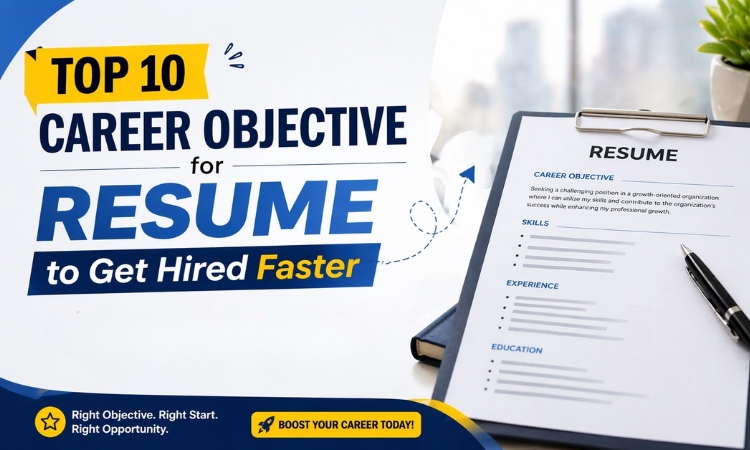
Top 10 Career Objective for Resume to Get Hired Faster

For today’s hiring landscape, recruiters spend less than 10 seconds scanning a resume before they decide whether they want to move forward. This means your opening statement has to work fast.  A highly crafted career objective for resume has the power to make a difference on your resume, getting buried or landing on the desk of the hiring manager. It is a lot more than just formality; this is your first and final chance to show how the skills can align with the needs of the company.  When this is written correctly, it can set the professional tone, highlighting the value and encouraging the recruiters to keep that reading. Whether you’re entering the job market for the initial phase, switching industries, or aiming for the leadership role, the objective can be sharp, tailored, and specific to the major position. Let’s explore how to write the one that can actually work, along with the majorly proven examples that can help you to adapt for the right job search.  What Is a Career Objective for a Resume? A major career objective for resume is a brief 2- to 3-sentence statement that’s placed at the top of your resume.  The purpose is highly simple: for the employers, what you can bring to the table and how you intend to contribute to their organization.  Unlike the older and outdated objectives that can be focused on for professional goals (“Seeking a majorly challenging role for growing your skills”), modern objectives are employer-focused and demonstrate how you can solve real business problems.  When this is done right, this can act as a major handshake before the recruiter can even dive into the work experience. Career Summary vs. Objective: Which One Should You Use? Most of the job seekers can confuse the career summary vs. objective, but they can serve completely different purposes.  This focus on your past achievements, metrics, and industry expertise, thus answering the question, “What have been accomplished?” A professional resume objective, on the other hand, is great for fresh graduates, career changers, or professionals that are re-engineering for the workforce.  This focuses on future goals, how you can plan for adding in the value plus the transferable skills for adding in the value. If you have less than the three years of experience that you can pivot from, an objective that makes more sense. How to Write a Professional Resume Objective That Works Creating the standout objective strategy and not just clever understanding. Follow these types of proven steps: Keep It Concise: Limit yourself to 2 to 3 sentences. Recruiters just want clarity and not fluff.  Tailor it for the Job: Mirroring the keywords from the job description. The ATS system and the human reviewers can look for the relevance.  Lead with value & not demands: Focus on what you’ll bring into the company, not what you want from them.  Include the measurable skills: The phrases like “hardworking team player” towards “seeking the growth opportunities” are overused and add zero value. A strong value professional resume objective that should read like a perfectly targeted pitch and not just a generic statement. Also Read: Top 20 Resume Summary Examples Top 10 Career Objective for Resume These are those real world career objective examples that’s custom built towards different industries and different career stages. Every one here is designed to pass those ATS filters while it can capture the recruiter attention:  For IT Freshers: Perfectly detail-oriented computer science with hands-on experience in languages like SQL and Python along with cloud deployment with the assistance of internships and academic projects. If you’re ready to apply the analytical skills towards solving software development initiatives and delivering the scalable and user-focused processes.  For Career Changers (Marketing to Data Analytics): The data-driven marketing professional with 4+ years of experience for campaigns, seeking to transition to data analytics. They are proficient in Tableau, SQL, and statistical modeling, with an advanced ability for translating complicated datasets to highly actionable business strategies that can help in revenue growth.  For the healthcare professionals: Registered nurse with 3 years of clinical experience in fast-paced emergency departments. These are certified in BLS and ACLS, with a great track record in patient advocacy, cross-functional collaboration, and accurate documentation. These are committed towards delivering the highest-quality care and support of operational efficiency at hospitals.  For Finance and Accounting: Analytics finance graduates that have expertise in finance modeling, budget forecasting, and ERP systems like SAP. Seeking to leverage the strong quantitative skills plus attention to detail for strategic financial planning plus compliance initiatives. For Project Management: The organized project coordinator with 5 years of experience that can manage the cross-functional teams plus deliver complicated initiatives on time and under budget. Skilled in agile methodologies, stakeholder communication, and risk mitigation. Get started with driving operational excellence plus process improvement. For Sales & Business Development: The result-driven professional with a consistent track record towards exceeding the quarterly targets by 20% for strategic relationship building plus consultative selling. Are you ready to leverage the proven negotiation skills plus market analysis expertise for expanding the client portfolios plus the revenue streams at the company?  For Customer Service & Support: Customer-focused expertise with around 4 years of experience and resolving volume inquiries and improving satisfaction scores by 35% and creating better workflows. Highly proficient in CRM platforms plus conflict resolution, with a grand commitment towards delivering exceptional client experiences at the company.  For human resources: HR with more than 3 years of experience towards right talent acquisition, policy compliance, and employee onboarding. Adept at the use of ATS platforms and conducting the structured interviews and fostering of great workplace culture. Seeking to support strategic HR initiatives and drive employee engagement at the organization.  For Supply Chain and Operations: Processing-oriented operations that are specialized towards inventory management, vendor negotiations, and logistics coordination. Proven stability towards reducing the supply chain delays for 15% of the data tracking and workflow optimization. Are you ready to contribute to cost-effective, scalable operations at the company?  For Executive

Top 10 Career Objective for Resume to Get Hired Faster Read More »

How To Write a Military to civilian resume, Some Important Tips You Should Follow

During the transition from the military to the civilian economy, a veteran will develop a military résumé. Vets may showcase their unique military experience, education, and skills in their resumes. The talents you have that are relevant to the positions you are applying for can be highlighted, just as they would be on a conventional resume. Your Veteran CV should demonstrate your commitment to your work and how you can use the abilities you learned in the Veteran in a civilian setting. Professional Resume Writing Services How to write a military to civilian resume To help you write this sort of CV, here are some tips: 1. Add summary statement. Include a brief overview of your talents and accomplishments at the top of your resume. Your talents, achievements or past job experience might be highlighted in this section. Recruiters will be looking for a statement that demonstrates your qualifications for the role and attracts their attention. Here are some examples. 2. Add skills section. According to what was said earlier, you want to state your talents in civilian language. If they are relevant to the employment, you can also include the abilities you had prior to serving in the military. A team of recruiters, for example, may have been under your management. Some of these abilities include team leadership and time management. There are numerous different sorts of jobs that you might fill using the abilities you’ve developed so far. 3. Give a brief description of your schooling. Never neglect to include your education on a resume. Indicate whether you attended any additional courses or seminars throughout your. You should also include a list of certificates on your resume if you have any. As part of the education portion of the website, they can also be listed separately under certificates and licenses. 4. List the duties you performed throughout your military service. You should highlight in your resume the accomplishments that are relevant to the professional route you’ve selected after leaving the military. For instance: As a result of a promotion to the rank of battalion commander in the Army, you have earned management experience. A career in human resources would benefit greatly from this skill set. This implies that you have some experience operating specialized electronic devices and understanding about computers, which may be readily transferred to positions in information technology. As a result of a promotion to the rank of battalion commander in the Army, you have earned management experience. A career in human resources would benefit greatly from this skill set. This implies that you have some experience operating specialized electronic devices and understanding about computers, which may be readily transferred to positions in information technology. 5. Include relevant awards and security clearances. Try to add security clearances in your “professional experience” section wherever applicable. Do not be precise while mentioning your security clearance, though. In the case of top-secret clearance in the military, for example, you can just declare that fact without detailing what you did with it. It is remarkable to hiring managers that you have a security clearance, since it demonstrates that you have through a thorough background check and can be trusted with sensitive information. 6. Use the job description’s keywords. Make a note of the keywords you notice in the job descriptions while you construct your CV. Those keywords should be included in your resume since the recruiting manager is especially looking for them. You can also utilize more civilian terminology in your paper as a result of this. 7. Translate any veteran jargon into civilian terms. In order to translate military jargon and codes into easy language for your veteran CV, you may refer to the following examples: veteran CV         Rather than stating that you “commanded” other individuals, state that you “supervised” or “directed” a group of people to reach a common goal.         Performance appraisal” is a better alternative to “Open Educational Resources.”         Substitute “relocation” for all instances of “PSC.”         Rather than referring to a battalion, use the term “organization.”         Use terms like “conflict” and “dangerous circumstances” to describe fighting.         Use the terms “employees,” “colleagues,” or “coworkers” to refer to your “subordinates.”         Rather than stating that you “commanded” other individuals, state that you “supervised” or “directed” a group of people to reach a common goal.         Performance appraisal” is a better alternative to “Open Educational Resources.”         Substitute “relocation” for all instances of “PSC.”         Rather than referring to a battalion, use the term “organization.”         Use terms like “conflict” and “dangerous circumstances” to describe fighting.         Use the terms “employees,” “colleagues,” or “coworkers” to refer to your “subordinates.” 8. Double- and triple-check the mechanics of your resume. Your resume should be reviewed before it is sent, just as you wouldn’t go into war without double-checking the operation of your weapon, your ammo supply, the amount of gasoline in your vehicle, or the number of troops in the squad. Simple mechanics like format, spelling, dates, and overall accuracy should be thoroughly checked on your veteran resume. Important Resume Sections for Military Veterans A veteran’s most important resume part is the “Key Skills” section, which should be based on a functional, skills-based resume style. Immediately following the resume summary, this part should include the bulk of the resume’s material. If you are looking for a position that requires a certain set of abilities, provide a description of those skills in the skills section of your resume. But you may also include a section called “Additional Talents” that gives a list of your skills without going into detail about each one. According to the profession they are looking for, veterans often have a record of accomplishments, credentials, and courses they’ve taken. Use a resume builder to create sections for

How To Write a Military to civilian resume, Some Important Tips You Should Follow Read More »

How to write the best career objective for resume for freshers

Best Career Objective for Resume for Freshers in 2026 | How to Write + Examples & Expert Tips

What do you think would make you stand out among other candidates in today’s competitive job market? Curating a flawless and presentable resume would be your definite answer but let’s dive deeper, shall we? The better answer to this question would be a well-crafted and concise career objective a Resume. Career objective is written at the top of the resume, mentioning your skills, strengths, goals, and ambitions that work to make a brief but excellent first impression on the recruiter. If you want to stand out in this fast-paced world, know that these impressions could decide your chances at scoring an interview and moving further towards your desired role. In this article, we will discuss drafting perfect career objectives for freshers so that they stand out in this competitive job market in 2026. Let’s begin by properly looking into the definition of career objectives again. What is the Career Objective For Resume? Usually consisting of one to three sentences, a career objective is placed toward the beginning of your resume that speaks for your skillset and intention with the job you are seeking. To make the points clearer: Why Career Objective in Resume is Crucial for Freshers? With the market expanding every other day and job applications increasing in number, freshers in particular must know how to put forward a perfect pitch to convince the recruiters of their abilities and their value to the company. Let’s take a look over the following points, and keep them in mind while drafting resumes. Pro Tip: Ensure that you modify the career objective in alignment with the job and company you are applying to. How to Write an Effective Career Objective Resume? Tailoring to the Job Description Emphasizing Strong Skills and Desires Keeping It Clear and Concise Including these subheadings and explanations will assist freshers in writing a more detailed and successful career objective that grabs attention and establishes the tone for the rest of their resume. Common Mistakes to Avoid in Resume objective: Top 15 Industry-Specific Resume Objective Samples and Examples: 1. Career Objective Resume Samples for College Students with no experience. Example 1: To secure a challenging job in my desired company, increase my experience and abilities and contribute to the overall development of the organisation.Example 2: A dedicated and highly disciplined person looking for a challenging job to gain work experience in this area.Example 3: To be able to work in an organisation that will be able to give me diversified chances to learn more, develop my skills, and learn and develop at work towards the organisational objective. 2. Career Objective Resume Samples for Internship Level for Freshers. Example 1: Junior in Computer Science with Java and Python proficiency applies for a software development internship at Tech Co. to utilise programming acumen and work on cutting-edge projects.Example 2: A Financial analyst aspirant with good analytical skills and investment theory coursework targets utilizing skills in XYZ Bank’s summer internship program.Example 3: A student of Environmental Science with a passion for green practices looks for an internship at Green Corp to help create environmentally friendly initiatives and attain practical knowledge in the field. 3. Career Objective Resume Samples for Web Developers: Example 1: Ambitious computer science graduate with excellent HTML, CSS, and JavaScript skills interested in an entry-level web development role to craft user-friendly web pages and make contributions to ground-breaking digital solutions.Example 2: With the aim of getting a job as a web developer in an innovative tech company where I can implement my proficiency in front-end frameworks and responsive design, and also grow my capabilities in back-end technologies.Example 3: Detail-oriented fresher with a passion for web technologies and coding, looking to join a creative team to develop interactive and efficient web applications. 4. Career Objective Resume Samples for Marketing Example 1: A very creative and resourceful person, a social media lover, looking for challenging roles in Digital Marketing to assist an organization in enhancing its brand awareness and establishing a successful online presence.Example 2: A result-driven and self-motivated candidate with excellent SEO and SEM skills applying for Marketing Associate at ABC Inc. for maximizing brand exposure and revenue through the finest techniques of digital marketing.Example 3: New marketing graduate looking forward to utilizing content generation and analytical talent in a dynamic marketing culture for spurring engagement and expansion of a progressive firm. 5. Career Objective Resume Samples for a Data Analyst Fresher Example 1: A Recent Statistics graduate looking for an entry-level data analyst role to apply analytical and problem-solving skills to analyzing data and informing business decisions.Example 2: Organized and technology-savvy professional looking to become a data analyst in a credible company with expertise in Excel, SQL, and data visualization tools to provide actionable insights.Example 3: To secure a data analyst position where I can utilize my knowledge of statistical analysis and data modeling to develop algorithms that will help the organization grow. 6. Career Objective Resume Samples for an Accountant Example 1: Fresh accounting graduate with a bachelor’s degree in accounting looking for a job as an accounting assistant which needs strong analytical, decision-making, and problem-solving abilities.Example 2: In pursuit of a beginning-level accounting position in which I can apply my accounting reporting skills and attention to detail to contribute to the goals of the finance team.Example 3: Determined and detail-focused professional seeking to begin an accounting career, with the aspiration of being able to impart solid organizational and analytical skills to a well-established organization. 7. Career Objective Resume Samples for Financial Analyst Professionals Example 1: Recent accounting graduate with a bachelor’s degree, looking for an accounting assistant role that demands high-level analytical, decision making, and problem-solving skills.Example 2: In pursuit of an entry-level accounting role where I can leverage my expertise in financial reporting as well as my attention to detail to contribute to the achievement of the finance team’s goals.Example 3: Dedicated and detail-driven professional seeking to begin a career in accounting, looking to bring strong organizational and analytical abilities to a respected organization. 8.

Best Career Objective for Resume for Freshers in 2026 | How to Write + Examples & Expert Tips Read More »

15 Proven Job Search Strategies to Land Your Dream Job Faster in 2025

15 Proven Job Search Strategies to Land Your Dream Job Faster in 2026

Searching for a job in 2026 can feel overwhelming. With tough competition, evolving technology, and AI-driven recruitment processes, standing out requires more than just a polished resume. If you’re submitting dozens of applications and hearing nothing back, you’re not alone—and you’re not doing it wrong. You’re just missing a proven strategy. In this guide, you will learn how to find a new job with 15 actionable strategies that will help you streamline your job search, build meaningful connections, and get closer to landing that dream job. Whether you’re a recent graduate or a seasoned professional making a change, these tips are tailored for today’s job market. Top 15 Job Search Strategies to Get a Job Faster in 2026 1. Be clear about your requirements: To develop a successful job search strategy, define your preferences regarding the types of jobs you seek: full-time, part-time, freelance, etc. Knowing what type of organization you belong to, like big firms or a niche company. You must consider the type of schedule that suits you best: A traditional 9-to-5 hours, late hours, etc. Knowing these factors beforehand will help you narrow down your job search more effectively.  To develop a successful job search strategy, define your preferences: Type of job: Full-time, part-time, freelance, hybrid, remote, or in-office Organization type: Startups, nonprofits, agencies, large corporations, etc. Work hours: Traditional 9-to-5, flexible schedules, weekends, or overnight Knowing these factors will help you focus your search and find opportunities that align with your lifestyle and goals. 2. Participate in Industry Conferences and Expos Try to maximize your networking options to create invaluable connections for potential long-term business opportunities.  Make sure to attend industry events and join any professional organizations related to your skill set, as such events may coincide on a weekly or monthly basis, thus allowing for regular interaction. Many events are online these days, enabling you to create that very important connection with an individual from your field.  Networking is one of the most powerful ways to uncover hidden job opportunities. Attend industry-specific events, both virtual and in-person Join professional organizations relevant to your field Follow up with people you meet via LinkedIn or email These recurring meetups build real relationships that go beyond a single resume drop. 3. Make your cover letter and CV stand out from the crowd There is a reason that typical workflow advice is such: changing the job title and name of the company in a cover letter is not nearly enough. Always cross-reference the strict requirements for submission after an application has been processed, just to ensure that everything is correct in the online application system. A generic resume won’t get you noticed. Tailor every document to each job. Highlight key achievements using measurable results Use keywords from the job description Ensure formatting works well with ATS (Applicant Tracking Systems) Before you hit submit, double-check all submission requirements to ensure proper formatting. 4. Make a Portfolio of your work Your portfolio is a variety of sample works that may include links to articles, screenshots of projects, reports, or videos.  The number of samples required varies according to the position; in general, graphic designers and writers have portfolios since they need to present works that are best experienced visually, whereas salespeople may not need to do so. Portfolios can be in the form of personal websites, splash pages, or even sections on your LinkedIn profile. Having or knowing some resume writing tips might help upscale your portfolio by a notch. This is your chance to market yourself and explain what makes you unique among applicants. A portfolio helps you showcase your skills visually or interactively. Include articles, videos, reports, designs, or screenshots Use a personal website, a LinkedIn section, or a splash page like About.me Tailor the content depending on your industry This is your personal showroom—use it to stand out. 5. Optimize Your LinkedIn Profile Once your profile is done, keep it updated by sharing articles, commenting on posts, and interacting with others. Putting hashtags in there enhances search ability, and one can think of posting things related to industry-related content or joining relevant groups to increase visibility for recruiters and potential employers. LinkedIn is one of the first places recruiters will check. Add a professional photo and an engaging headline, and a summary Use keywords relevant to your target roles Regularly share posts, comment, and engage with content Also, join niche LinkedIn groups and make use of hashtags to increase visibility. Know more: How to optimize your Linkedin Profile 6. Informational Interviews The informational interview may be a great networking tool as it connects you to professionals with whom you would someday want to work in their organization. Use LinkedIn or email to request a short discussion about their roles. Remember, the purpose is gleaning information and not to seek employment or references. These casual conversations can turn into serious opportunities. Reach out via LinkedIn/email and ask for a 15–30 minute chat Come prepared with thoughtful questions Don’t ask for a job; ask for insights 7. Techniques for Succeeding in Your Job Search In a slow job market, motivation is hard to sustain unless there are job enthusiasts. Realistically applying job search techniques allows differentiation among applicants in the eyes of the employers, allowing for a reward sooner through effective efforts. Stay adaptable and reflective during your search. Learn from each rejection or non-response Ask for feedback when possible Constantly tweak your strategy based on what’s working 8. Use the Right Job Boards Broad job sites really make it easy to discover a whole variety of job opportunities and local employers. However, if you’re looking to drill down, you should try searching the specialized job boards for your specific career or role.  For freelancing or remote job opportunities, there are options like FlexJobs. Others may be for short-term or contract work. So, these resources will really help to make your job search fast and easy. Not all job boards are created equal. Use both general and niche platforms. General:

15 Proven Job Search Strategies to Land Your Dream Job Faster in 2026 Read More »

transferable skills resume

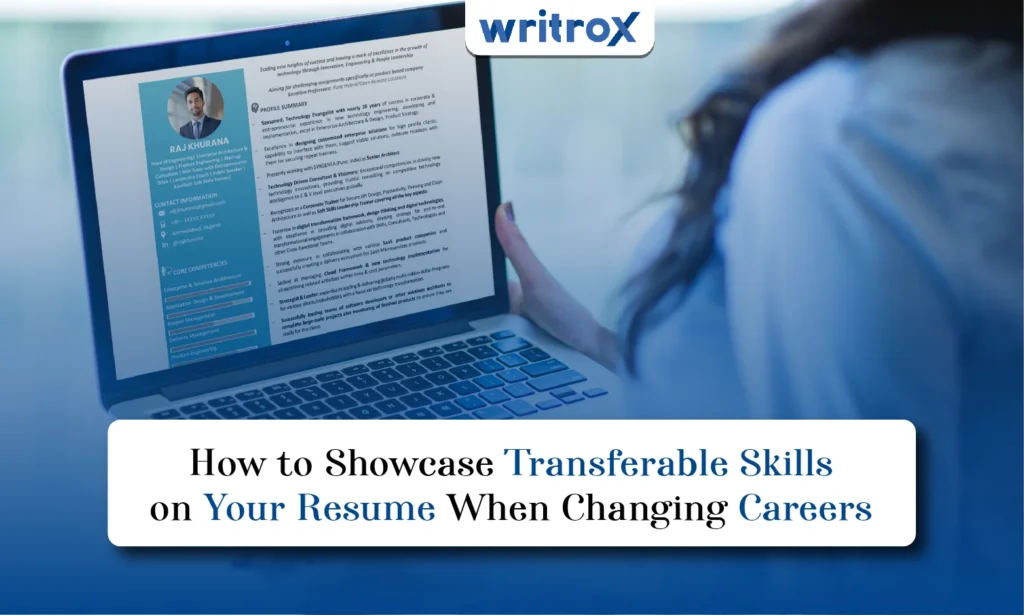
How to Showcase Transferable Skills on Your Resume When Changing Careers

The transition between two careers can be exciting and scary at the same time, given the fact that it is not easy to show your skills to market them, to expose your experience in a new field that is quite different. How you demonstrate your transferable skills on your resume can make or break your chances of successfully changing careers. Such as the skills you acquired and learned in your earlier jobs, which can be transferred to your new career, even when you are coming from a different industry. So through this blog now let’s understand how to create a career change resume. 1. Understanding Transferable Skills  Transferable skills are skills that transfer from one role to another or even from one industry to another. They are crucial for anyone looking to change careers. This includes things like communication, leadership, adaptability, and teamwork – qualities to achieve good rapport in almost any role, and not the only trait in the mix. Plus, hard skills like project management, data analysis, or specific software knowledge tend to be measured and needed through particular training or experience, which helps to add technical depth to your profile. 2. Choose the Right Resume Format  Choosing the correct resume format is one of the most important steps in shifting your job skills resume. For a career changer, a functional resume will be best because it downplays a chronological work history. Instead, your core competencies go at the top, right where the eye goes—so the reader sees skills, not job titles, first. Or, a combination resume mixes functional and chronological styles, focusing on your skills as well as your work experience list in order. Using the right format can allow you to point the reader in the direction of your strengths and transferable skills, reducing the disconnect between your previous experience and the new career path. If you feel that you are unable to figure out the right resume format then you can hire a resume-writing service provider. 3. Spot and Highlight Related Skills that you are Transferring Instead, to punch your resume, choose the transferable that seem most relevant and focus on those. Review the job description and identify the skills or qualifications that seem to be the key to the job application in question. If you are clear about your strengths, you will know which of your skills to highlight. Here are some transferable skills most people possess: 4. Build a Section Called Skills Summary Once you finish writing your resume header, the Skills Summary is the next section to write because it highlights your best and most relevant transferable skills. The Skill should be a bullet point, and then an example of showcasing that skill in your prior job. Example: This is also a good starting point for the hiring managers to find the skills you offer in no time. 5. Write a Career Change Summary or Objective Statement As you are switching fields, a Career Change Summary or Career Objective Statement, when written properly, helps to explain your pivot as proactive and goal-focused. This statement should convey: Example: Seasoned Client Relationship Manager transitioning to Human Resources. Demonstrated ability to communicate, manage team, and resolve issues. A people-first HR enthusiast who is keen to employ client-facing skills to improve employee satisfaction. 6. Highlight Relevant Experience with Action-Oriented Language Your employment background may not be used to be involved in the new field, but you can make it relevant to show certain skills. The action-oriented language is preferred to describe accomplishments and skills compared to just filling in the responsibilities. Example: Old phrasing: “Took customer calls.” New phrasing: Daily handled over 50 customer inquiries. Listened to customers and provided the best solutions, with 98% satisfaction. If the job is in a different industry, highlight results and accomplishments instead, that show your skills. 7. Incorporate Relevant Projects or Freelance Work If you did freelance work, volunteer projects, or online courses closely related to your desired role, include these in a separate Projects or Portfolio section. A track record of the real world or self-described projects can fill that gap between experience and responsibility. You can get in touch with a CV Writing service provider in case of getting your CV professionally done Example: “Conducted data analysis for over 20 projects, with the analytics providing actionable insights that increased customer satisfaction scores by 15%.” Including relevant projects also indicates that you take initiative and are not afraid to go against the stream to learn new skills and easily make a transferable skills resume section. 8. Show Professional Development Efforts Taking relevant courses or certifications in your new area is an ideal way to show your dedication to your career transition. Even if they are not formal qualifications, they can be added to your resume and help boost your profile.  Examples: These achievements prove your commitment to learning help enhance the credibility of your skill set and help to showcase Transferable Skills Resume easily 9. Use Keywords to Pass Applicant Tracking Systems (ATS) A lot of organizations utilize an ATS (Applicant Tracking System) to detect resumes. Adding words from the job description enhances your chances of getting by these systems. This may include certain terms related to the industry or skills such as “data analysis,” “client management,” or “strategic planning. Try to put these keywords into your resume naturally (particularly in the Skills Summary section and Work Experience section) and increase the chances of your resume getting in front of the hiring person  Conclusion Switching careers is not an easy task, but a good resume that emphasizes your transferable skills resume will help you stand out. However, selecting the best format, honing in on position-relevant skills, and providing clear examples can help you build a resume that proves you have what it takes to succeed in a new field. Highlight how your previous experience equips you with what it takes to make the next step in your career; own your strengths! These strategies will put you on

How to Showcase Transferable Skills on Your Resume When Changing Careers Read More »

ATS resume pitfalls

Why Your Resume Isn’t Getting Noticed: Common ATS Pitfalls

According to studies, it is assumed that 70% of résumés are never seen by a human recruiter. They are filtered out by an ATS ( Applicant Tracking System). That is why the eligible candidates are not getting shortlisted for a job opportunity. Their résumés do not meet whatever standard the technology has set. This has become an important issue for job seekers who wait to be shortlisted for interviews. This article highlights the importance of Resume writing as per ATS and some widespread pitfalls that can result in rejection. By identifying and avoiding these mistakes, job seekers can increase their visibility and chances of getting noticed. The following sections will reveal the most essential reasons why resumes often fail to pass ATS filters, with tips on what to do to optimize their applications for success. Understanding ATS and Its Role in Recruitment An ATS enables any company to organize candidates for hiring and recruiting. They can also be used in businesses of any size and industry to collect candidate information, organize prospects by experience and skill set, and filter applicants. What is an ATS? An ATS ( Applicant Tracking System) refers to software used by organizations to facilitate recruitment efficiently. It automates the gathering and analysis of job applications by scanning resumes for keywords and qualifications. The ATS streamlines the hiring process by filtering out unqualified applicants. Hence this is giving recruiters enough time to spend on the more suitable ones. In this respect, understanding how ATS works is very important for job seekers to ensure that their resumes get through these automated filters to the hiring managers. Common ATS Pitfalls to Avoid There are some common ATS pitfalls to be aware of while Resume writing. If the formatting is too complex like elaborate layouts, images, and non-standard fonts it confuses the system and could misinterpret your qualifications. If the relevant keyword is not used in the resume or there is high use of graphics, or a proper file format is not used, the ATS gets confused to certify the resume and eventually it fails. 1. Overly Complex Formatting One of the most common errors on most resumes is complicated formatting, which misguides the applicant tracking systems in most cases. Elaborate designs with pictures and fonts that are not the usual variety are most likely to create misinterpretations of critical information by the ATS. Clean formatting and standard fonts like Arial or Calibri will enhance the prospect of getting through the filters of the applicant tracking system. Bring out your qualifications clearly with simple headings and bullet points to make your resume easy to read. 2. Missing or Incorrect Keywords Keywords are important to be included in the resume because they make sure, first of all, that your resume matches the job description and will go through to human eyes, and it helps both the ATS and human eyes realize how well a candidate fits the job. Look for keywords directly in the posting and other identical positions. These words should be used naturally throughout the resume in the skills, experience, and achievements sections. This shall be done without the risk Dof overstuffing to ensure readability. Keyword insertion is best done by using pipes to separate the keywords and placing them either above the ‘About’ section or below the main title of the resume. 3. Avoid Abbreviations When it comes to avoiding another pitfall, it’s about avoiding abbreviations. ATS might not recognize abbreviations, this is because key details can be missed. So, always try to spell out terms like job titles and qualifications. E.g., “Bachelor of Science” is better than “B.Sc.” It will ensure that the system will properly identify your qualifications, which will ultimately increase your chances of being shortlisted. 4. Not Using the Right File Type Always avoid submitting your resume in an incorrect file format, like PDF or image files. It can cause ATS to skip the vital information. When it comes to most preferred formats, then most of the systems prefer .docx or .txt formats as they are easier to scan. 5. Avoid Tables Avoid making use of tables as ATS often struggles to read the content that exists within tables. It can lead to important details being ignored. Whereas, if you use plain text and bullet points, it will ensure that the system can easily scan and understand all parts of your resume. Ultimately, it leads to an increase in the likelihood that it passes the initial screening process. The Role of Resume Writing in Navigating ATS One of the effective ways through which applicant tracking systems are helpful to companies to sort through the great number of resume applications is by scanning through resumes for keywords related to any particular job description. This will let a recruiter go through all of the resumes efficiently and pick out those that best fit the position. Through the use of ATS ( Applicant Tracking System), companies will be able to optimize their hiring process and make sure only the best-matched applicants move forward to the following steps. Tailoring Your Resume for Each Job Application The most important thing when applying for jobs these days is to tailor your resume to each job application. Doing this might get you past the applicant tracking systems that all companies use nowadays. Applicant tracking systems look through your resume, seeking particular keywords and phrases that appear in the description itself. For that reason, no such general resume will pass the very first screening. To increase your chances, go through the job posting very carefully. Look for the necessary key skills, qualifications, and specialized terms in that industry. Next, work on your resume by filling it with keywords such as skills, experience, and summary. Use standard fonts to make the resume ATS friendly, and avoid complex layouts. When you get your resume as close to the job description as possible, it increases the chances of it getting through the ATS and into the hiring manager’s eyes. Balancing ATS Requirements with Human Readability Make a resume

Why Your Resume Isn’t Getting Noticed: Common ATS Pitfalls Read More »

The Role Of Keywords In Your Resume And How To Use Them?

The Role Of Keywords In Your Resume And How To Use Them? 

Market conditions are also an influential factor today, and as a job seeker in the current competitive market crafting a resume that stands out is very important.One of the most effective strategies to improve your resume visibility is using the right keywords in a resume. These resume keywords are words or phrases taken from job descriptions or industry standards. They help Applicant Tracking Systems (ATS) and recruiters understand whether your resume matches the job role. Integrating these keywords in strategic places on your resume helps you not only get through the initial digital filtering but also showcases how closely related you are to the position. In this guide, we will explain: What are keywords in a resume Why using keywords in resume writing is important What keywords should you use in your resume How to add keywords to resume effectively What Are Keywords in a Resume? Keywords in a resume are specific words or phrases that highlight your skills, qualifications, and experience relevant to a job. These can include job titles, technical skills, certifications, tools, and industry-specific terms that employers and Applicant Tracking Systems (ATS) look for. Simply put, when you think about what are resume keywords or what are keywords on a resume, they are the exact terms that match the language used in job descriptions. Using keywords in resume writing helps your profile get noticed by recruiters and pass ATS filters. Whether you’re adding keywords to a resume or researching the right resume writing keywords, the goal is to align your resume with the job role. By choosing the right keywords to use in resume writing, you increase your chances of landing an interview and showing you’re a strong fit for the position. Role of Keywords in Your Resume Applicant Tracking Systems (ATS) Most companies use Applicant Tracking Systems to streamline the hiring experience. ATS software reads the job description and searches for particular keywords in a resume. Without these keywords in your resume, and then ATS will not be able to shortlist your resume and there are chances of getting rejected. Including the right keywords will allow your resume to pass through the ATS and make it over via a recruiter or hiring manager and it is important to make an ATS Friendly Resume to get your resume into visibility. Pointing out your skills  Keywords point to the areas of skill and experience that these jobs are asking for when posting positions. This way, with the right keywords you will be able to highlight the skills and characteristics that align against it and help your chances of reducing in a more interesting candidate. Improve Keyword Search When you are looking for a position, recruiters at the job boards or on LinkedIn type keywords such as Java Developer to find resumes. Adding the right keywords to your resume improves the likelihood of it showing up in such searches, thereby increasing visibility and getting you to potential employers. Match with the Job Descriptions  Keywords can support your resume matched up to a specific job description. When you customize your resume with the terms and language used in these job posts, it shows that you paid attention to what was asked for and are a good fit. This alignment will increase the chances of getting your resume in front of a hiring recruiter to continue advancements through the process. How to Incorporate Keywords into Your Resume? Learning How to Tailor Your CV For Each Job Application Is Essential That includes integrating the keywords used in that particular job posting into your resume so it fits right within what is hopefully a keyword-targeted request on their end. Below is an in-depth guide on how to do this effectively with your resume and if you need any CV writing service to create a professional CV or not. Review the Job Description and Add Keywords First, review the job description (JD) of that particular opening in-depth. Identify Skills, Qualifications & Industry Jargons Used Integrating these keywords naturally throughout your resume helps demonstrate that this gig is right up your alley. This will make your resume stand out and get noticed by both Applicant Tracking Systems (ATS) as well as hiring sellers. Job Description Keywords: Project Management Data Analysis Team Leadership Example: Organized and managed multiple projects concurrently; employed advanced project management practices to provide on-time results. Worked on detailed data analysis to help strategic decision-making and presented strong leadership skills in managing team Use Headings and Breaks Effectively Use clear section headings and vertical bars (pipes) to divide up sections in your resume, this way ATS – and recruiters alike can easily find what they’re looking for. E.g. Separate your resume body into major sections using vertical bars. Such as, for example – Section Headers: Experience | Skills | Education All headings should be declared and have corresponding descriptions. Here you need to paste your job roles and responsibilities separated in bullets under the experience section. For the “Skills” section, skills are arranged under categories such as “SEO & Digital Marketing”, “Content Creation & Copywriting,” or “Technical Skills”, and individual skill is listed within each category using separating vertical bars. The final section “Education” should list your educational awards discovered, and in a formal way.so the sections are distinct from each other Structuring your resume in organized sections improves readability and keyword optimization. Update Your Summary Update your summary statement to include keywords specific to the job you are seeking. Your Key Capabilities, Experiences, and Qualifications are directly related to the job description. Ensure the terms are seamlessly integrated, showing how you are a great fit for the job from word one. Original Summary: An expert, having experience in managing and analyzing something. Revised Summary: Highly skilled project manager with 5+ years of relevant experience in data analysis and team management. A history of delivering successful project results and utilizing analytical capabilities to advance strategic enterprise initiatives. Highlight Key Keywords Bold your keywords to highlight key skills and qualifications in a resume. It helps these terms

The Role Of Keywords In Your Resume And How To Use Them?  Read More »

perfect resume for job

What Are the 7 Basic Steps to Write a Perfect Resume for Job?

Every list of recommendations for writing resumes will include the following advice: A smart place to start is with your contact information. Your name, a contact number, an email address, and, if available, links to your website and LinkedIn profile. Make a list of every job you’ve ever had after that. A resume is not just a simple document; it’s a main way for an employer to know who you are. It’s the way to display your skills, your achievements, and your experience as well. A perfect thing to highlight your overall skills. Unfortunately, many candidates who are seeking a job do not understand the importance of a strong resume. Through this blog, we will discuss 7 basic steps for perfect resume writing. With this blog you will learn a lot about creating a great resume to get yourself hired in the job you always wanted. 7 Basic Steps to Writing a Perfect Resume for Job There is a lot more to it than that, though. The Seven basic steps listed below will help you develop your resume-writing abilities and create a document that will help you succeed: 1. Come up with a Hook The area at the page’s top is highly desired. To entice someone to give your CV more than a glance, you need to include something at the top that will pique their interest. Once upon a time, a goal statement describing the kind of position the applicant was seeking would appear immediately below the candidate’s contact information on a resume. These days, a lot of recruiters and hiring managers expect to see a succinct paragraph that reads more like a profile of the applicant. For the next thirty seconds, use the crucial two or three sentences below as your elevator pitch: They should give a succinct overview of your education and experience and highlight your skills that are pertinent to the type of job you are seeking. In both your CV and Cover Letter, go into further detail about your qualifications. 2. Illustrate the Effect The majority of the content on your CV should be devoted to your professional experience. Your prior roles should be listed in reverse chronological order, beginning with the most recent and working your way backward. You should be results-oriented when outlining your duties and accomplishments. That necessitates you to give detailed information on how you contributed to a project or the organization. 3. Incorporate Soft Skills Remember that the success of your profession depends on having excellent interpersonal skills. Skills like excellent writing and verbal communication, critical thinking, the capacity for time management, creativity, and problem-solving abilities are in high demand nowadays. You absolutely must list them on your CV. But how might these qualities be demonstrated, as opposed to simply being listed? A smart place to start is by creating a well-designed resume and cover letter. Both of these documents can demonstrate your writing skills clearly if they are carefully organized, free of grammatical and spelling errors, and customized for the position you are applying for. To demonstrate abilities like the capacity to work with people, adapt to change, and take the lead, you can also highlight your accomplishments and professional experience. 4. Emphasize your Knowledge of Technology Give others access to your software skills and technical knowledge. For instance, candidates interested in an Administrative Assistant Position or a similar position must know Microsoft Office. With each of the applications in the suite, as well as any training or certification programs they have completed, intelligent candidates will indicate their levels of knowledge. Many professions will demand the usage of more sophisticated technologies. Utilizing the job description as a guide, talk about your experience using the software required for the task. Once more, the list should include education and credentials. Include a reference to pertinent software in your career history for even more proof that you have professional experience. See this link for more information on how to make an interesting section for your resume that highlights your skills. 5. Be Original We will cover how to highlight talents that are relevant to the position or the company in this section of our guide to how to write a resume. Your ability to communicate fluently in a foreign language, for example, may provide you with an advantage in getting an interview with the employer if the company conducts business on a global basis. You can tell you have leadership skills because you are running a Meetup group for people in your field. Whatever your interest, use your distinctive skills and background to set yourself apart. Share some of your hobbies and interests outside of work; many recruiting managers prefer to have a more complete picture of potential employees. Just be careful not to overdo it by giving a comprehensive list of all your particular interests and pastimes. Never forget that your resume is a crucial piece of professional writing. 6. Employ Relevant Keywords  Many companies use submitted resumes and cover letters as the basis for keyword searches to find applicants with experience in the necessary disciplines. Create a customized version of your resume for each job posting that you answer, including adding some of the languages from the job description. Use the appropriate terminology in your CV rather than using a more casual phrase like “keeping track of schedules” if, for example, the business is searching for a candidate with experience in “maintaining executives’ calendars.” 7. Verify for Errors! A potential employer needs very little evidence to rule you out of consideration while going through a stack of a dozen or more resumes. To find any grammar or spelling mistakes, your application has to be carefully reviewed. In addition to running your work through a spell check, read it slowly out loud so you can focus on every word. Finally, before you give in to your work, have a close friend review it. Something as basic as a typo can jeopardize your chances of receiving an interview. Conclusion Having a good resume

What Are the 7 Basic Steps to Write a Perfect Resume for Job? Read More »

Call Now WhatsApp Now