Most people really don’t enjoy writing cover letters at all. You finally finish your resume. You update your LinkedIn profile. You spend half the day searching for jobs. Then you click on some promising role and suddenly see those words again. “Please submit a cover letter.”
Many job seekers either skip the cover letter completely or write something so generic that the same letter could be sent to literally any company anywhere. The problem is that hiring managers notice this kind of thing very quickly.
But the good news is that learning how to write a cover letter is actually much easier than most people think. You don’t need fancy business language. You don’t need to sound like giving a TED Talk either. You just need to explain why you’re interested, why you’re a good fit, and why the company should bother talking to you.
A strong resume gets a foot in the door. A strong cover letter helps open that door a little wider.
In this guide, we will go through exactly how to write a cover letter content that feels genuine, professional and worth reading. We will also look at cover letter examples, common mistakes, and tips for writing a cover letter that hiring experts wish more candidates actually knew.
What Is a Resume Cover Letter?
Before getting into how to write a cover letter, let’s clear up something that many job seekers still ask about. What exactly is a cover letter?
A cover letter is basically a short document that goes along with your resume when applying for any job. Usually it’s around one page. Its job is not to repeat everything already sitting inside your resume. Its job is to connect the dots between things.
Think of it like this.
Your resume says:
- Where have you worked
- What skills do you have
- What results you achieved
Your cover letter explains:
- Why are you applying?
- Why you are interested in that particular company
- Why your experience matters for this specific role
Many people search online for what a cover letter example is because they worry about writing the wrong thing altogether.
Here’s the thing, though. The best cover letter examples are not the ones with the fanciest words. They are usually ones that sound like a real person talking about a real experience in an honest way.
Why a Cover Letter Is Important for Job Applications
Some people think cover letters are dead now. They are not. Are they required for every single job? No, not always. Do all recruiters even read them? Also no. But many hiring managers still do read them. And when they do, a strong cover letter for job applications can give you quite a good advantage over others.
Imagine two candidates with very similar resumes.
One sends only a resume. The other one sends a resume plus a personalised cover letter explaining why they are excited about the role and how their experience matches the company’s needs.
Who stands out more? Usually second person, almost every time.
A cover letter for job applications can help you do several things, like showing enthusiasm for the position, explaining career changes, addressing employment gaps, highlighting achievements that deserve more context, and demonstrating communication skills. And good communication is something almost every employer looks for anyway.
Essential Elements of a Professional Cover Letter
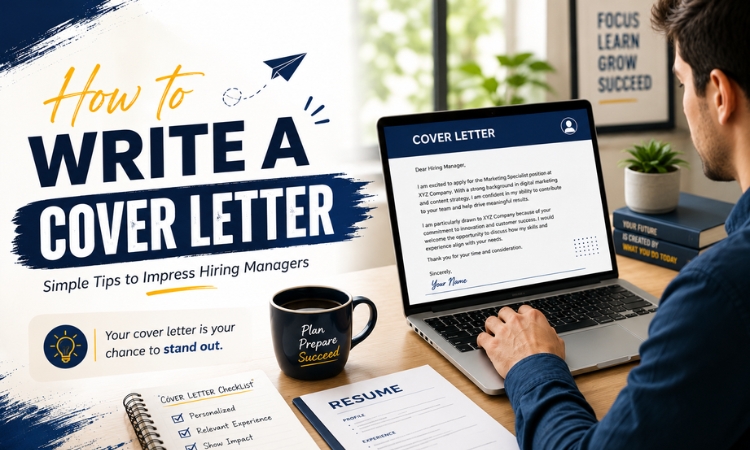
If you are wondering what should a cover letter include, most good cover letters follow a pretty simple structure, actually.
- Contact Information
Start with the basics. Include full name, phone number, email address, LinkedIn profile if relevant, and location. No need to write the entire life story here. Just make it easy for employers to contact you.
- Professional Greeting
If possible, try to find the hiring manager’s name. A greeting like “Dear Sarah Thompson” usually feels much stronger than “To Whom It May Concern.” If the name cannot be found, then “Dear Hiring Manager” works perfectly fine.
- Strong Opening Paragraph
This is where many people mess up quite badly. Some candidates start with boring lines that look clearly copied from the internet somewhere. Instead, just get straight to the point.
Mention the position you are applying for, why you are interested, and a quick reason why you are a strong fit. Good cover letter opening lines give recruiters an immediate reason to keep reading further.
For example, something like this works well. “When I saw the Marketing Manager opening at your company, I knew I had to apply. With six years of experience growing digital campaigns and improving customer engagement, this role felt like a very natural next step for me.” These kinds of cover letter opening lines immediately set the right tone.
- Main Body Paragraphs
This is where you sell yourself. Not aggressively. Not awkwardly. Just confidently.
Talk about relevant achievements, key skills, projects you worked on, and results you delivered. The strongest cover letter examples don’t try to mention everything at once. They focus only on experiences most relevant to that particular role. Understanding what is a cover letter example that works means understanding this balance properly.
- Closing Paragraph
Keep it straightforward. Thank the reader and express interest in discussing the role further. That’s really it. No need for dramatic statements about how this opportunity would completely change your entire life.
- Professional Sign-Off
End with something professional like Sincerely, Best Regards, or Kind Regards. Then add your name. Simple always wins here.
Step-by-Step Guide to Writing a Winning Cover Letter
Now, let’s get into the practical part of how to write cover letter content properly.
1. Research the Company and Job Role
Before writing anything, spend a little time researching first. Seriously, even five or ten minutes can make quite a big difference. Look at the company website, recent news, their mission and values, and the job description carefully. Hiring managers can usually tell very easily when someone actually understands their business versus when someone is just applying to fifty jobs using the exact same template everywhere.
2. Customise Your Cover Letter for Each Application
This is probably the most important tip in this entire guide. Don’t send the same cover letter everywhere. Recruiters notice. Hiring managers notice. Pretty much everyone notices this.
When learning how to write a cover letter content that actually works, personalisation is a really non-negotiable thing. Mention the company name. Reference specific role. Talk about why you are interested in their business, particularly. Small details make a surprisingly big difference overall.
3. Highlight Relevant Skills and Experience
This is not the place to list every single skill you have ever learned in life. Focus only on what matters most for that role. Read the job description carefully and then match your experience to their requirements properly. Strong resume skills examples can support an application, but make sure they are connected to real accomplishments. Anyone can claim they are a leader. Showing how you led a project that increased revenue by 25 per cent is a much more convincing thing altogether.
4. Use Quantifiable Achievements
Numbers are your best friend here. Whenever possible, include measurable results in your writing. Things like increased website traffic by 40 per cent, reduced customer complaints by 22 per cent, managed a team of 15 employees, or generated 50 lakh in annual sales. Specific achievements feel real and believable. Generic claims really don’t.
5. Keep the Content Clear and Concise
A cover letter is not supposed to be a very long document. Most hiring managers are quite busy. Really busy. Aim for one page only. Short paragraphs help. Clear language helps. Getting to the point quickly helps. If something doesn’t add value, just remove it without thinking too much.
6. Proofread Before Sending
This sounds obvious, but many people skip it anyway. Double-check the company name, job title, grammar, spelling and resume writing format before sending. Few things look worse than sending a cover letter to Company B while mentioning Company A in the first paragraph. And yes, this happens all the time, surprisingly.
Tips from Hiring Experts for Different Career Levels
Here are some expert tips for writing a cover letter directly from recruiters to increase your chances of getting hired for the role you’re applying for:
- Entry-Level Candidates
If you are just starting out, don’t panic about lacking experience. Employers already know that. Focus on internships, projects, volunteer work, certifications and academic achievements instead. A strong career objective for resume also helps at this stage. Potential matters. Enthusiasm matters. Willingness to learn matters quite a lot, too.
- Mid-Level Professionals
At this stage, employers want evidence of growth mainly. Show promotions, leadership experience, major accomplishments and problem-solving skills. This is where concrete results become especially important to mention.
- Senior-Level Candidates
For experienced professionals, the conversation changes quite a bit. Hiring managers care mostly about impact at this level. Talk about business growth, team leadership, strategic decisions, revenue generation and organisational improvements. Show how you influenced outcomes rather than just completed tasks.
Common Cover Letter Mistakes to Avoid
Some mistakes show up again and again quite commonly.
- Using generic templates.
- Making the cover letter too long.
- Repeating the entire resume inside the cover letter.
- Talking only about what you want instead of what the company actually needs.
- Using weak opening lines.
- Ignoring proofreading completely.
Don’t forget the difference between a resume and a cover letter. Your resume tells things. Your cover letter explains those things. Both documents should work together and not just copy each other.
How Resume Writing Services Can Help Improve Your Cover Letter
Not everybody enjoys writing about themselves. Actually, most people really don’t. That is why resume writing services remain quite popular even now.
Professional writers understand hiring trends, ATS requirements, resume writing format best practices, and effective cover letter structure. They can also help improve resume summary examples, career objective for resume sections, cover letter content, and keyword optimisation. Sometimes an outside perspective helps you identify strengths you have been overlooking.
Conclusion
Learning how to write a cover letter is not about sounding smarter than everyone else. It is about making a genuine connection with an employer.
A good cover letter shows why you are interested, why you are qualified, and why you are worth speaking to. Keep it personal. Keep it relevant. Keep it focused on the right things.
And most importantly, remember that hiring managers are real people. They are not looking for perfect corporate language at all. They are looking for someone who can do the job well and communicate clearly. That is exactly what a great cover letter should help you do.
FAQs
1. Do employers still read cover letters in 2026?
Yes, they do. Not every employer reads them, but many still do. A strong cover letter can help you stand out, especially when candidates have similar qualifications to each other.
2. How long should a resume cover letter be?
Ideally, one page only. Most recruiters prefer concise and focused cover letters that get to the point quickly without wasting time.
3. Should a cover letter be different for every job application?
Absolutely yes. Customising your cover letter shows genuine interest and helps align your experience with the specific role you are applying for.
4. What should I avoid including in a cover letter?
Avoid generic statements, unnecessary personal information, negative comments about previous employers, and content that simply repeats the resume word-for-word.
5. Is a cover letter necessary if it is optional?
In most cases, yes. If given the opportunity, submitting a thoughtful cover letter can help strengthen your application and differentiate you from other candidates quite effectively.
Career notes from our writers
Once a fortnight, our resume writers send one short email on what is actually getting people shortlisted. No fluff, unsubscribe any time.

Written by
Rahul Ranjan
Rahul Ranjan is the Founder and Director of Writrox Solution Private Limited, where he has spent the last several years helping professionals transform the way they present themselves in today's competitive job market. From early-career professionals to CXOs and founders, his work has supported thousands of individuals in building stronger professional identities through strategic resumes, LinkedIn profiles, executive biographies, and personal branding.