
A resume can tell a recruiter what you did, but that alone doesn’t always show how well you did it. “Managed social media”, “handled clients” or “worked on sales” may be true, but they don’t really tell the full story.
This is where learning how to quantify achievements on resume becomes useful. A few genuine numbers can show the scale of your work, the results you created and the kind of responsibility you handled without making your resume unnecessarily long.
The good part is that you don’t need impressive revenue figures for every role. Projects completed, hours saved, people trained, customers handled or even a percentage improvement can all become useful numbers when they actually represent your work.
What Does It Mean To Quantify Achievements?
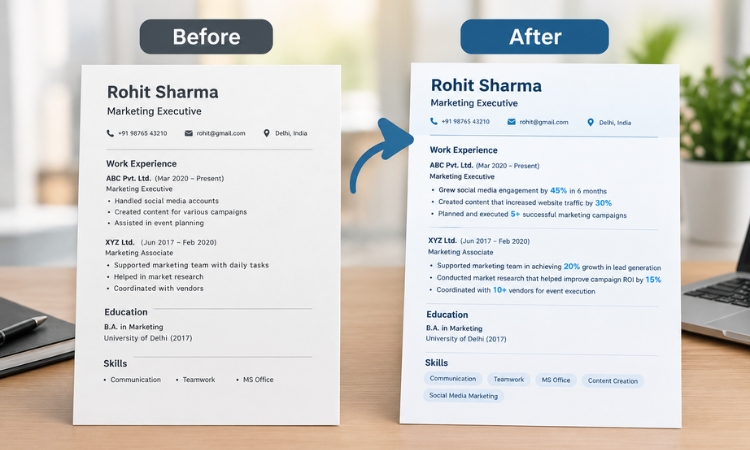
Quantifying an achievement means adding a measurable result to something you have done at work. Instead of only describing the responsibility, you show what changed, improved, increased, decreased or was completed because of your contribution.
This makes the statement easier to understand. A recruiter can see not just the task, but also its scale and outcome.
Start With A Simple Definition
Consider the difference between “Managed email marketing campaigns” and “Managed email campaigns that increased click-through rates by 25%.”
Both statements describe the same area of work. The second one, however, gives the reader a result to understand.
That number doesn’t need to be huge. It just needs to be accurate and relevant to the work.
Look For Measurable Results In Your Work
There are many ways to measure an achievement. You may have generated ₹20 lakh in revenue, reduced expenses by ₹3 lakh or increased sales by 18%.
You could also have saved 10 hours every week, completed 25 projects, managed a team of 12 people or improved customer satisfaction from 82% to 91%. These are all useful measurable achievements on resume because they add actual scale to your experience.
Don't Think Only About Money
Revenue and sales are easy numbers to notice, but they’re not the only useful ones.
A teacher could mention the number of students taught. A software developer could mention applications built or load time reduced. An HR professional might mention 100+ hires handled in a year. The right metric depends on what your job actually involved.
Why Should You Quantify Achievements on Your Resume?

Recruiters often scan resumes quickly. When several candidates have similar job titles and responsibilities, measurable results can help one resume become easier to understand.
Numbers give some context to otherwise general statements. They also help you show that your work had a real outcome, rather than simply listing everything you were expected to do.
Numbers Show The Scale Of Your Work
“Handled customer accounts” doesn’t tell much by itself. Did you handle five accounts or 150?
Changing it to “Managed 120+ customer accounts across three regions” immediately gives the recruiter a better idea of your workload.
The same thing applies to projects, teams, budgets and locations. A number can sometimes explain your level of responsibility in just a few words.
Achievements Can Make Your Resume More Specific
Job responsibilities are often similar across candidates. Achievements are where your individual contribution starts becoming clearer.
For example, several marketing professionals may write that they “managed digital campaigns”. A candidate who says they “increased qualified leads by 32% through paid and organic campaigns” gives the recruiter something more specific to remember.
If you’re also deciding what information belongs in different parts of your application, it’s useful to understand Resume Vs Cover Letter. Your resume should show the evidence of your experience, while the cover letter can provide more context around your interest and fit.
How To Identify Achievements Worth Quantifying?
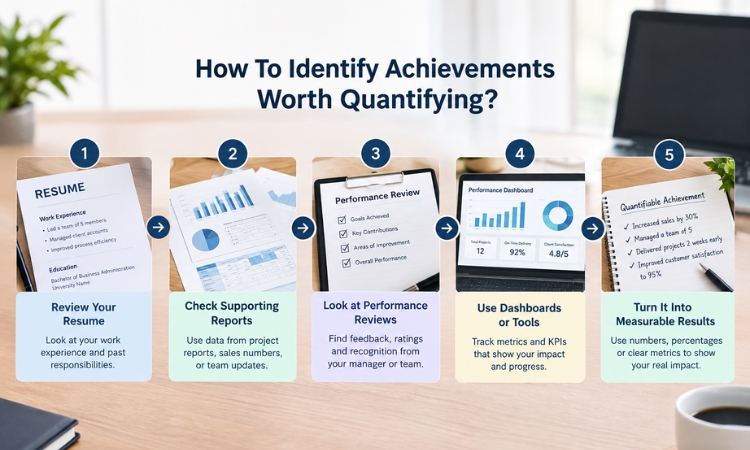
The hardest part isn’t always writing the number. Sometimes it’s finding the number in the first place. Start by looking at the work you have already done. Your old reports, project documents, performance reviews and emails may contain useful information that you don’t remember immediately.
Go Back To Your Biggest Projects
Think about the projects where you had a clear role. Ask yourself how many people were involved, how long the project took, how much money was involved and what was delivered.
A line such as “Coordinated website migration” can become “Coordinated migration of 150+ website pages, completing the project two weeks before the deadline.” Now the recruiter knows the size of the project and the result.
Look At Performance Reviews And Reports
Performance reviews are often a good place to find numbers. Sales targets, customer ratings, productivity figures, hiring numbers and project results may already be recorded there.
You can also look through dashboards and monthly reports if they’re available to you. Just make sure you’re not sharing confidential company information on your resume.
This process can also help you understand which Skills To Write In Resume are actually supported by your experience, instead of simply copying common skills from online resume templates.
What Metrics Can You Include on a Resume?
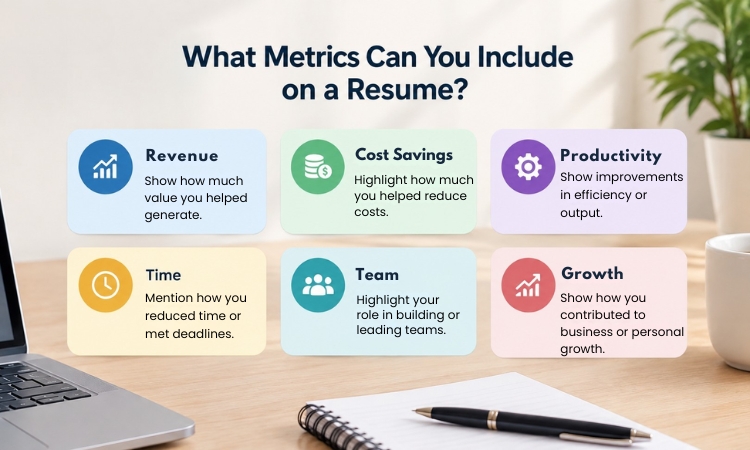
The best metrics depend on your profession, but there are some categories that work across many industries. Think about money, savings, performance, time, scale, teams, and growth. You don’t need to use all of them. Just pick the ones that make your work easier to understand.
- Revenue And Sales
For sales and business roles, one can mention revenue generated, sales growth, deals closed, targets achieved, or new accounts acquired.
For example, “Generated ₹80 lakh in annual sales, exceeding the assigned target by 15%.” Another option could be “Closed 60+ B2B deals in 12 months.”
These numbers work well because they directly connect your activity with the business results.
- Cost Savings
Cost reduction is especially useful for finance, operations, procurement, and management roles.
You could mention expenses reduced, budgets managed, or money saved through some new process. “Reduced annual vendor expenses by ₹4 lakh through contract renegotiation” is much more specific than just saying “managed vendor contracts.”
- Performance And Productivity
Performance metrics can show that you made a process faster, more efficient, or more productive.
Maybe you increased output by 20%, reduced errors by 30%, or helped the team to process 500 more requests every month. These numbers show improvement without needing a direct financial result behind it.
- Time Saved
Time is also a valuable metric to use. If your work saved employees several hours weekly or reduced turnaround time, then mention it.
For example, “Automated weekly reporting and reduced preparation time from six hours to two hours.” That’s a clear achievement, and it also tells the recruiter that you improved the process somehow.
- Scale And Team
Scale can include customers served, projects handled, or locations managed. Team metrics can include employees managed, trained, or hired by you.
A statement like “Trained 45 new employees across two locations” gives much more information compared to simply saying “conducted employee training sessions.”
- Growth
Growth metrics can include website traffic, leads, conversions, followers, or customers gained. These are particularly useful for marketing, sales, content, and digital roles, mostly.
For example, “Increased organic website traffic by 48% over eight months through SEO and content improvements.”
An important thing here is to choose metrics that actually connect with the role you are applying for.
Turn Responsibilities Into Quantified Achievements
A lot of resumes get stuck at the responsibility stage only. The candidate writes what they were assigned, but doesn’t explain what happened after completing that work.
One simple Before → After approach can help to change this.
Write Down The Original Responsibility
Start with a basic task without worrying too much about making it sound impressive.
For example: “Managed customer support requests.”
Then ask yourself, what happened because you managed those requests? Did response times improve? Did the number of unresolved complaints fall? Did customer satisfaction increase?
Add The Measurable Outcome
Now connect the task with its result.
“Managed customer support workflow, reducing average response time by 35%” is much stronger than the original line.
This is also where many resume accomplishment examples become useful. They show the general structure, but you should always replace their numbers and situations with your own genuine results honestly.
Keep The Before And After Easy To Read
Don’t turn one achievement into a long paragraph. A good resume statement can often be just one or two lines.
For example:
- “Redesigned employee onboarding process, reducing training time from 10 days to seven.“
It’s simple. It tells what you changed and what happened after that.
How To Quantify Achievements When You Don't Have Exact Numbers?
Not every job comes with neat dashboards and monthly performance reports. Sometimes your company simply didn’t measure the result formally. That doesn’t mean you have to leave every achievement vague, though.
- Use Reasonable Estimates Carefully
If you know that you generally handle around 30 to 40 customer queries every day, you can use an approximate figure if it genuinely reflects your workload. But don’t turn an estimate into an unnecessarily precise number. Writing “handled 37 customer queries daily” when you only remember handling around 30 to 40 can create questions later on.
- Use Ranges And Scale
You can use phrases such as “20+ projects,” “100+ customers,” “across four locations,” or “team of 15” when exact figures are not available. This still communicates the scale without pretending you have data that you don’t actually have.
- Use Time And Frequency When Results Are Hard To Measure
Frequency can also be a useful form of measurement. “Prepared weekly reports for a 40-member sales team” gives useful context to the reader. Likewise, “Conducted monthly training sessions for 60+ employees” shows regular responsibility and scale even when there isn’t a percentage improvement to mention.
Common Mistakes To Avoid
Quantification can make a resume stronger, but only when done properly. Adding random numbers just to make a statement look impressive can actually make the resume weaker instead.
Numbers should support your story, not distract from it.
- Don’t Invent Numbers
Never create a revenue figure, percentage, or customer count just because a resume looks better with one. If you cannot verify the number, use a reasonable range or just leave it out completely. You should also be able to explain where your figures came from, in case the interviewer asks about it.
- Don’t Use Percentages Without Context
“Improved performance by 50%” sounds impressive, but the reader has no idea what actually improved. Instead, explain the metric properly. “Increased qualified leads by 50% in six months” is much clearer.
- Don’t Put Numbers Everywhere
Not every line needs a metric in it. Forcing numbers into statements where they don’t add anything can make a resume feel quite unnatural. This matters especially when you are following a specific resume writing format. Page still needs to look clean, readable, and easy to scan through.
- Don’t Forget The Actual Achievement
A number by itself is not an achievement. “25%” means very little without action and context around it. Try to connect all three parts: what you did, what changed, and how much it changed after.
Quantified Resume Achievement Examples by Job Role
Different professions naturally have different ways for measuring success. So your metrics should match your role rather than copying numbers, which sounds impressive in some other industry. Here are some practical examples to give you a starting point:
Sales Professionals
Sales professionals can use revenue generated, sales growth, deals closed, targets achieved, and new accounts acquired.
- “Generated ₹1.5 crore in annual revenue, exceeding sales target by 18%.“
- “Closed 75+ B2B deals across five major accounts, contributing to 22% year-on-year sales growth.“
These statements quickly show both performance and scale together.
Marketing Professionals
Marketing professionals have plenty of possible metrics, including traffic, leads, conversions, campaign engagement, and customer acquisition.
- “Increased organic website traffic by 45% in eight months through SEO and content campaigns.“
- “Generated 3,500+ qualified leads through paid and organic campaigns, improving conversion rate by 17%.“
The exact metric depends on what your marketing work was actually responsible for.
Software Developers
Developers can quantify applications built, features delivered, bugs reduced, response time improved, development time saved, or system performance overall.
- “Reduced API response time by 35% by optimizing database queries.“
- “Developed and launched 12 product features across three major releases.“
These examples can be especially useful while applying technical Resume Tips For Software Engineers, where showing the outcome of technical work is often more useful than just listing programming languages known.
Project Managers
Project managers can use project budgets, delivery timelines, team sizes, cost savings, and completion rates.
- “Managed a ₹2 crore technology implementation project with a cross-functional team of 16.“
- “Delivered 14 projects within agreed timelines while reducing average project turnaround time by 20%.“
These figures show responsibility as well as execution.
HR Professionals
HR professionals can quantify hires, recruitment time, employee training, retention, and engagement.
- “Managed recruitment for 100+ positions annually across technology and sales teams.“
- “Reduced average hiring time by 22% by improving candidate screening and interview coordination.“
Numbers can make HR work much easier for recruiters to understand, because many HR responsibilities otherwise sound quite similar to each other.
Finance Professionals
Finance professionals can mention budgets handled, reporting timelines, transactions processed, cost savings, and forecasting improvements.
- “Managed monthly financial reporting for a ₹15 crore business unit.“
- “Reduced monthly reporting turnaround time by two days by improving data consolidation processes.“
For candidates who are considering professional support, resume writing services in India can also be useful when they need help in identifying which achievements are worth highlighting for a specific industry.
Conclusion
A strong resume doesn’t need numbers in every single sentence. What it needs is enough evidence to show what you actually achieved, how much responsibility you handled, and what changed because of your work.
Start with your regular responsibilities, then look behind them a little. How many people have you worked with? How many projects have you completed? How much time did you save? Did sales increase, costs fall, or customer satisfaction improve?
Once you start looking at your experience this way, writing achievements becomes much easier. You don’t need to exaggerate your career or fill a page with percentages everywhere. Use genuine numbers, keep the language simple, and let results speak for themselves.
Career notes from our writers
Once a fortnight, our resume writers send one short email on what is actually getting people shortlisted. No fluff, unsubscribe any time.

Written by
Rahul Ranjan
Rahul Ranjan is the Founder and Director of Writrox Solution Private Limited, where he has spent the last several years helping professionals transform the way they present themselves in today's competitive job market. From early-career professionals to CXOs and founders, his work has supported thousands of individuals in building stronger professional identities through strategic resumes, LinkedIn profiles, executive biographies, and personal branding.