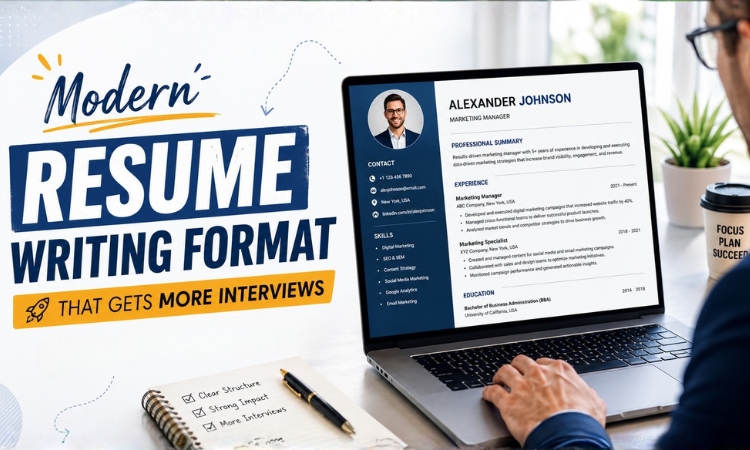
Recruiters don’t read resumes nowadays; they skim through them. In fact, recruiters spend just six to eight seconds going through your resume and deciding whether or not you’re eligible for a role. And in these six/eight seconds, what recruiters are looking for is not the job title or even the name of the college you graduated from. They’re looking for a story, a pattern, and evidence of how much impact you were able to bring in your specific role at a company. If you want to stand out in your recruiter’s attention, you need to be able to show effective career progression on your resume.
Two candidates could have the same 8 years of work experience, yet one of them may come off as a person who’s been steadily advancing, while the other may come off as stuck. And this is not a skill issue; it’s rather the ability to show the development on paper.
In this guide, you’ll learn exactly how to show career progression on your resume, regardless of whether you worked for one company or five.
What Is Career Progression on a Resume?
Career progression is the record of how you developed throughout your professional life. It could involve changing positions, gaining more responsibility, being in charge of larger teams, getting involved in riskier and more important projects, and having more and more money tied to your decisions. It’s the before and after of your career path, presented in such a manner that anyone can tell in a second that the person in front of them is developing.
The ideal resume writing format is the one that doesn’t showcase career progression like this:
- Same bullet points mentioned again and again across three different jobs
- No evidence of change
- No numbers or other details showing how the first and the fifth years were different
This doesn’t mean the person didn’t develop during that time. They just didn’t write it down.
How to Show Career Progression on Your Resume
Here’s the part most people tend to skip. Below, you’ll find all the practical tips on how to showcase career progression in a manner that anyone who sees it notices immediately.
Group Multiple Promotions Under One Company
If you got promoted twice or thrice within the same organisation, don’t list them as three separate, disconnected entries scattered across the page. Group them under one company header, then break out each title with its own dates underneath. Something like:
ABC Solutions Pvt. Ltd. (2019 to 2024)
- Senior Manager, Marketing (2022 to 2024)
- Manager, Marketing (2020 to 2022)
- Executive, Marketing (2019 to 2020)
Of all the formatting choices you could make on a resume, this resume career progression tip carries more weight than most people realize. A recruiter sees it and understands immediately, without doing any mental math, that you got promoted more than once at the same company. That’s not something you have to explain. It just shows.
Highlight Promotions Clearly
Don’t bury the fact that you got promoted somewhere in a paragraph. Say it outright. A line like “Promoted to Team Lead after 14 months for consistently exceeding quarterly targets” does more work than five vague bullet points ever could. Recruiters like clarity; they don’t like guessing games.
Show Increasing Responsibilities
Growth isn’t only about titles changing; sometimes the title stays put, but the scope quietly expands. Maybe you went from managing 2 people to managing 12. Maybe your budget authority tripled. Write that down. This is one of the more overlooked ways to show career growth on a resume without needing an actual promotion to point to.
Quantify Your Growth
Always prioritise numbers over statements or text on resumes. “Improved team efficiency” is not impactful. “Improved team efficiency by 34%, reducing average delivery time from 9 days to 6” is very impactful and effective. Write a number, a percentage, a monetary figure, a headcount, or anything else measurable wherever you can.
Focus on Achievements, Not Just Job Duties
There’s a huge difference between “responsible for managing client accounts” and “grew client retention from 68% to 91% over two years by restructuring the onboarding process.” One’s a job description. The other’s proof that you did the job well and got better at it over time. This shift, from duties to outcomes, is basically the backbone of professional growth in resume writing.
Why Career Progression Matters to Recruiters
Recruiters aren’t trying to check whether you meet all the technical requirements. They’re trying to predict the future. They want to know whether the person will keep developing there or whether they’ll eventually stagnate after six months. So, evidence of steady career advancement on a resume gives away ambition, consistency, and readiness to take on more responsibility.
At the same time, this approach quietly reduces risk for the recruiting manager. A person with a proven record of growth is more likely to keep developing further than someone with six years of work experience and no title changes at all. So, you should know what skills to write in a resume for maximum impact.
How to Show Career Progression When Changing Companies
This is where people often get confused. In case you’ve switched companies rather than climbed the career ladder within the same company, the main thing is to make each step look like a strategically planned advancement, not a sideways move. Here are some things to be mindful of:
- Arrange your job titles in chronological order and check whether each new job gave you more scope, more people, more money, or higher strategic significance compared to the previous one.
- Use your resume summary at the top to connect these dots explicitly, saying something like “Marketing professional with a record of taking on increasingly larger teams and budgets across three companies.”
- Avoid ambiguous titles that hide the growth; if you kept the same title when changing companies but gained more responsibility, make that clear in the bullets.
Resume Examples: Before vs. After
Sometimes it’s just easier to see it side by side.
Aspect | Before | After |
Job titles | Listed flatly, no context | Promotions clearly marked with dates |
Responsibilities | Same 3 bullets across all roles | Scope visibly increases role to role |
Achievements | Vague, duty-based statements | Quantified outcomes with numbers |
Career narrative | Reads like a job history | Reads like a growth story |
Before:
- Marketing Executive, XYZ Corp (2019 to 2024)
- Managed social media accounts
- Handled email campaigns
- Coordinated with the design team
After:
- Senior Marketing Manager, XYZ Corp (2022 to 2024): Led a team of 6, grew organic reach by 58% year over year
- Marketing Manager, XYZ Corp (2020 to 2022): Owned campaign strategy across 3 product lines, increased lead generation by 41%
- Marketing Executive, XYZ Corp (2019 to 2020): Managed social media and email campaigns, grew subscriber base from 4K to 12K
The “after” version isn’t just a list of duties anymore. Each line adds to the one before it, and by the end you’re reading something closer to a story of growth than a record of tasks.
How to Make Career Progression Easy to Scan
Recruiters skim resumes most of the time. So, the layout of information plays just as important a role here as the actual content. So, here’s what you should do:
- Boldly highlight job titles and promotion dates.
- Write achievements in bullet points. Maximum of one per line, never a whole paragraph.
- Apply reverse chronological order consistently, putting the latest experience first.
- Create some blank space between roles so they don’t blend into one continuous chunk of text.
- If relevant, consider using a small table or timeline diagram to illustrate senior roles. This is one of the best resume tips for senior professionals.
Career Progression Example by Experience Level
Obviously, no two career trajectories are alike. But it’s still possible to roughly outline the career progression steps based on experience.
Early Career: Intern → Executive → Senior Executive
Here, you should focus on demonstrating how fast you were able to learn the needed skills and tools, and gradually move from small to bigger tasks.
Mid Career: Executive → Team Lead → Manager
Personal and process aspects become more important at this stage, and your task is to show that you managed to move from individual contributions to leading other people.
Senior Career: Manager → Senior Manager → Director
Now the emphasis shifts to strategic elements, cross-functional impact, budgets and business results that can be attributed to you personally. Highlight these in your resume.
Executive Career: Director → VP → C-Suite
Day-to-day tasks lose their importance now. What counts instead is vision, organisation-wide decisions and measurable transformations.
Quick Checklist: Does Your Resume Show Career Growth?
Check this list before sending out your application.
- Your promotions are obvious and highlighted in bold font.
- Your responsibilities are increasing from position to position.
- You have quantified your accomplishments with specific numbers.
- You have demonstrated the growth in your leadership capabilities.
- Your skills and competencies become more sophisticated over time.
- Your career moves are logically consistent.
- Your career progression is formatted to be easily scannable.
Conclusion
Showing career progression on a resume is not about inflating your accomplishments. It’s about showcasing your progress in a clear and visible way. Highlight your promotions, quantify your successes, demonstrate your growing scope of responsibilities, and format the information in such a way that a tired recruiter, who has to go through fifty resumes in an hour, can spot your career progression at once.
And if writing this down yourself feels too challenging, or even impossible, or you’re simply not sure how to present your own career story, then professional resume writing services in India can help you. Get in touch with experts to increase your chances of selection.
Career notes from our writers
Once a fortnight, our resume writers send one short email on what is actually getting people shortlisted. No fluff, unsubscribe any time.

Written by
Rahul Ranjan
Rahul Ranjan is the Founder and Director of Writrox Solution Private Limited, where he has spent the last several years helping professionals transform the way they present themselves in today's competitive job market. From early-career professionals to CXOs and founders, his work has supported thousands of individuals in building stronger professional identities through strategic resumes, LinkedIn profiles, executive biographies, and personal branding.