You have finished writing your resume. Your education details are in place, your skills are listed and you have added your work experience or projects. But just when you think it is ready you come across one more section declaration. Should you add it? What should you write? These are common questions, especially when you are creating a resume for the first time. You might have seen the familiar line I hereby declare that all my information provided above is to the best of my knowledge. But is that the only way to write it? Well that’s not true. Your declaration can be simple and professional without sounding like a legal document. The wording can also change slightly depending on whether you are a fresher or someone applying for a specific job.
What is a declaration in a resume?
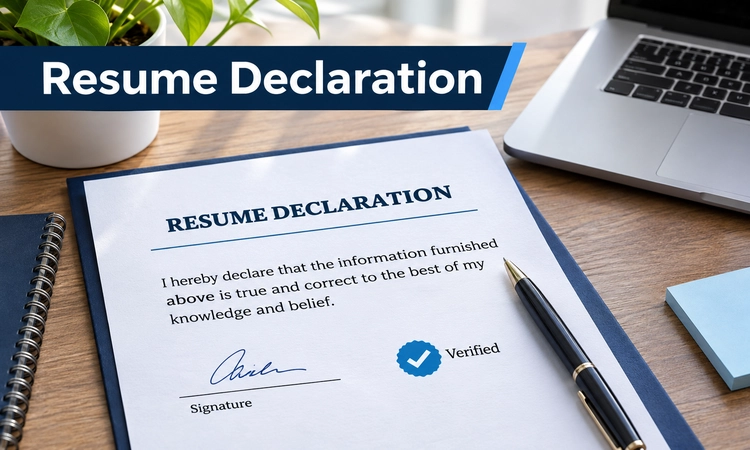
A resume declaration is a short statement at the end of your resume when you confirm that the information you have shared is connected to the best of your knowledge. Think about it this way. Your resume tells an employer about your education skills, previous jobs and achievements. A declaration simply confirms that you have provided these details honestly. For example, I hereby declare that all the information provided in the resume is true and correct to the best of my knowledge. That’s it you don’t have to write a long explanation or use complicated words. You might have noticed that older resume formats often include a declaration along with date, place, and signature. The format is still used in some formal applications, especially when your employers ask candidates to follow a specific structure.
Is declaration necessary in a resume?
This is probably one of the first questions that comes to your mind when you’re preparing your resume. The simple answer is no. You don’t need to include a declaration in every job application. Some employers prefer a traditional resume format with a declaration at the end. You might also find it required in government job applications or other formal recruitment processes. But many private companies do not expect candidates to add one. For example, if applying for a software developer position at a private company, the recruiter will be more interested in your technical skills and experience, including the Skills to Write in Resume, rather than just the declaration at the bottom of your resume. The best approach is to check the job requirements before adding this section.
How to write a declaration for your resume?
You don’t need to spend too much time writing this section. A declaration is meant to be short and simple. The idea is to confirm that your resume contains genuine information not to explain your entire professional background again.
Keep the statement short and professional
There is no need to write 5 or 6 lines when one or 2 sentences can do the job. A short statement looks neat and is very easy to read. For example I confirm that all details mentioned in the resume are accurate to the West of my knowledge. This is enough for most situations where a declaration is required.
Use simple and formal language
You don’t need difficult English to make your declaration sound professional. Avoid casual expressions but don’t make the statement unnecessarily complicated either. You can start with phrases like I hereby declare that or I confirm that. You can choose one that sounds natural.
Ensure the information is accurate
Before adding a declaration take a few minutes to check your resume. Are your educational qualifications correct? Have you mentioned the right employment dates? These details matter. For example if you have mentioned a certification make sure you have completed it.
Add the date place and signature when required
Some traditional resume formats include the candidates name, date , place and signature below the declaration. You can follow the format if you are submitting a printed resume or if your employer specifically asks for the details.
25+ best declaration samples for resume
Now comes the part you probably need the most: Actual declaration examples. The wording you choose can depend on your experience and the job you are applying for. A fresher might want to confirm the economic details while someone with several years of experience might need to cover the employment history and professional background.
Resume declaration for freshers
Writing your first resume can feel a little confusing. You might not have full time work experience to mention but you still have plenty of information to include like your education and academic projects.
1. Simple declaration for freshers
I hereby declare that all information provided in this resume is completely true and correct to the best of my knowledge.
2. Professional declaration for freshers
Confirm the educational qualification skills and other details mentioned in this resume are accurate and have been shared honestly.
3. Declaration for students applying for their first job
I declare that information provided in this resume including my educational background and academic achievements is connected to the best of my knowledge.
4. Declaration for resume after graduation
I hereby confirm that educational qualification projects and other details mentioned in the resume are accurate and can be supported with relevant documents if required.
5. Declaration for internship applicants
I confirm that the information shared in this resume about my education and skills is genuine and accurate to the best of my knowledge.
Resume declaration for experienced candidates
If you have already worked for a few years your resume will look quite different from that of a fresher. You might have details about previous companies or job responsibilities.
6. Declaration for experience
I hereby declare that the professional experience qualifications and other information mentioned here are true and accurate to the best of my knowledge.
7. Declaration for candidates with 2 to 5 years of experience
I confirm that the employment history skills and project details shared in the resume represent my professional experience accurately.
8. Declaration for senior-level professionals
I certify that the career history, professional achievements, and leadership responsibilities mentioned in the resume are accurate and have been presented honestly.
9. Declaration for managerial positions
I hereby confirm that the information provided in this resume including my managerial experience, team responsibilities and professional accomplishments is correct to the best of my knowledge.
10. Declaration for candidates changing careers
I confirm that the educational qualifications, transferable skills, and work experience mentioned here accurately reflect my professional background.
Resume declaration samples for different job roles
Should you write a basic declaration for every job role? Not necessarily. A basic statement works for most applications. But if you want your declaration to reflect your professional background you can use one of the examples here.
11. Declaration for IT and software professionals
I declare the technical skills software knowledge and certifications mentioned in this resume are accurate to the West of my knowledge.
12. Declaration for marketing professionals
I confirm that the marketing experience, campaign responsibilities skills and professional achievements listed in this resume are true and accurately presented.
13. Declaration for sales executive
I hereby declare that the sales experience client handling responsibilities and performance details mentioned here are correct to the best of my knowledge.
14. Declaration for HR professionals
I confirm that the information provided in this resume including my HR experience and professional qualifications is accurate .
15. declaration for accounting and finance jobs
I hereby declare that my education qualifications, accounting skills certifications and profile experience mentioned here are true and correct.
16. Declaration for teaching jobs
I certify that the academic qualifications, teaching experience and other details mentioned in the resume are accurate to the best of my knowledge.
17. Declaration for government job applications
I declare that the information and documents submitted along with this resume are true and correct to the best of my knowledge and belief.
18. Declaration for engineering jobs
I confirm that the engineering qualifications, technical knowledge and other professional details mentioned in the resume are accurate.
19. Declaration for banking jobs
I hereby declare that educational qualifications and work experience and other details provided in this resume are true to the best of my knowledge.
20. Declaration for customer service jobs
I confirm that the information shared in this resume including my customer service experience and communication skills is accurate.
Short and modern resume declaration examples
If you are applying to a private company, you might prefer a clean and simple resume format. You don’t always need a traditional declaration with a date and place signature.
21. One line resume declaration
I confirm that all the information provided in the resume is accurate to the best of my knowledge.
22. Formal resume declaration
I hereby certify that the details mentioned in the resume are true and have been provided in good faith.
23. Simple and honest resume declaration
The information shared in the resume accurately reflects my qualifications and skills.
24. Declarations for a corporate resume
I confirm that the professional and academic information included in the resume is accurate and can be verified if required.
25. Declaration for a resume without date and place
I declare that the information provided in the document is true and correct to the best of my knowledge.
Where to Put the Declaration in a Resume?
If you have decided to include a declaration, place it towards the end of your resume. It should come after the sections that recruiters are unlikely to look at first, such as your work experience, education, skills, and certifications.
A traditional resume may follow this order:
- Contact information
- Resume headline or professional summary
- Skills
- Work experience or internships
- Education
- Projects and certifications
- Declaration
I hereby declare that all information provided in the resume is true and correct to the best of my knowledge.
Place: Mumbai
Date: 07 November 2026
Name: Your Full Name
Signature: (Only if required)
Resume Declaration vs. Resume Objective: What's the Difference?
These 2 sections are sometimes confused, particularly if it shows they are preparing their first resumes. But they have completely different purposes. A declaration confirms that the information in your resume is correct, while a resume objective tells the employer what kind of role you are looking for and what you hope to contribute. Understanding this difference also helps present your Career Progression on Resume more clearly and professionally.
Basis of Comparison | Resume Declaration | Resume Objective |
Purpose | Confirms that the information in your resume is accurate. | Explain your career goals and what you hope to bring to a role. |
Main Focus | Accuracy of the details provided. | Skills, career interests and professional direction. |
Placement | Usually at the end of the resume. | Usually near the top, below contact details. |
Length | Generally one or two sentences. | Usually two to three concise sentences. |
Who Can Use It? | Freshers and experienced candidates, when required. | Candidates who want to communicate their career goals, particularly freshers and career changers. |
Example | I confirm that all information provided in this resume is accurate to the best of my knowledge. | Recent graduate seeking an entry-level marketing role where I can apply my communication skills and knowledge of digital marketing. |
Do's and Don'ts of Resume Declaration
A declaration is a small section so you might think there is not much to get wrong. But using unnecessarily formal language, adding too many details, or making claims you cannot support can make it look less professional.
Do’s | Don’ts |
|---|---|
Keep it short and clear: One or two sentences are usually enough. Confirm that the information in your resume is accurate without repeating the same point. | Don’t write lengthy paragraphs: A declaration is not an explanation of your career. Avoid using several lines to repeat the same information. |
Use professional language: Choose simple words that match the tone of your resume. Complicated vocabulary is unnecessary. | Don’t use casual expressions: Avoid everyday conversational phrases that may not suit a professional resume. |
Check your details: Review your qualifications, job dates, and achievements before confirming that the information is correct. | Don’t make false claims: Never confirm information that you know is incorrect. Your declaration should reflect details you can genuinely stand behind. |
Frequently Asked Question
What is the best declaration for a resume?
A good declaration is short, clear, and accurate. You can use: ” I hereby declare that all the information provided in the resume is true and correct to the best of my knowledge.
How do freshers write a declaration in the resume?
If you are a fresher, you can write a simple statement confirming that your educational qualifications and skills are correct.
Can I write a resume without declaration?
Yes, you can submit a resume without a declaration unless the employer or application specifically asked for one.
Should I include my signature in a resume declaration?
A signature is generally not required on a digital resume. You might include one if you are submitting a printed resume or if the employer specifically requests a signed declaration.
Is the declaration mandatory for experienced candidates?
No, experienced candidates do not have to include a declaration in every Resume. If the employer does not ask for one focus on presenting your work experience and measurable achievements clearly.
Can I use the same declaration for every job application?
Yes, you can use the same basic declaration if it accurately describes the information in each resume.
Conclusion
A declaration is one of the simplest sections to write in a resume but that doesn’t mean you need to add it every time. If an employer asks for one, keep it short and make sure the details in your resume are correct. If this is not required you can leave it out and use that space for information that helps your application. You can use relevant action verbs for resumes, learn how to quantify achievements on a resume and present your career progression on a resume clearly.
Career notes from our writers
Once a fortnight, our resume writers send one short email on what is actually getting people shortlisted. No fluff, unsubscribe any time.

Written by
Rahul Ranjan
Rahul Ranjan is the Founder and Director of Writrox Solution Private Limited, where he has spent the last several years helping professionals transform the way they present themselves in today's competitive job market. From early-career professionals to CXOs and founders, his work has supported thousands of individuals in building stronger professional identities through strategic resumes, LinkedIn profiles, executive biographies, and personal branding.